
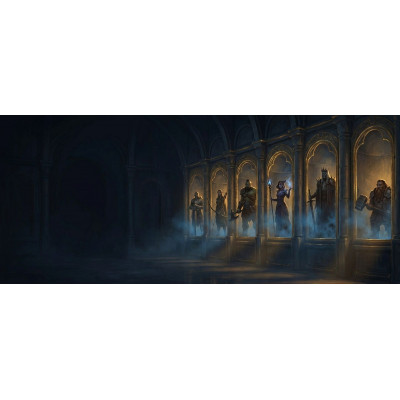
Siege is a clan mode where buildings fall not to the strongest rosters but to the best-organised ones. Below is a practical breakdown: how to split attacks, what breaks tough garrisons, and how to set a defence that survives the first wave.
How Siege Works: Durability, Garrisons and Points
Clans fight over buildings. Each one has a durability pool and a garrison made up of the owning clan's champions. While a building stands, it scores points; when its durability hits zero, it flips to the attacking side — the exact conditions depend on the season rules.
The real resource is not energy but the limited number of attacks each player gets per phase. Siege is attack management first and team building second.
- Durability drops with every attack. One attempt rarely demolishes a solid building; accumulated damage does the job.
- Garrison is visible in scouting: team composition, Speed, buffs, gear. That is free information — do not waste it.
- Points come from destruction and holding. Flank buildings are usually cheaper to break but worth less.
Clan Prep: Roles, Scouting, Communication
Siege is decided before the first hit — in planning. A clan that all attacks wherever the crowd goes burns more attempts than a weaker but coordinated one.
- Scouting. Assign 2–3 players to check garrisons at phase start and mark soft targets versus walls you cannot crack.
- Splitting. Most of the clan hits 2–3 key buildings; a smaller group finishes flanks and half-dead targets.
- Out-of-game comms. In-game chat gets buried fast: a target list in Discord or a messenger saves dozens of attacks.
- Personal prep. Everyone needs 2–3 attacking teams for different garrison types — control, poison, anti-heal.
Attacking: What Actually Breaks a Building
A Siege attack team is not an Arena team. You do not need a one-turn nuke; you need a stable clear through 4–5 garrison champions with enough survivability to get there.
Three working archetypes
- Speed control. Speed aura, decrease Speed, stun and freeze. Great against garrisons without high Resistance.
- Poison and HP-based damage. Kael is the textbook example: poison lands on tanks regardless of how thick they are, which shreds beefy shield garrisons.
- Anti-heal and buff block. Mandatory against garrisons with healers and revivers, otherwise the fight never ends.
Thresholds below which a team does not work
Your key controllers want 200+ Speed, and Accuracy must match the Resistance of the specific garrison. Miss Accuracy and your debuffs bounce, turning a great roster into free points for the defender. Against heavy garrisons, do not dump every attack at once: use the first run as a test and follow up with whatever actually worked.
Defending: A Garrison That Burns Enemy Attempts
A garrison does not need to kill everything — it needs to force the attacker to spend more attempts than planned. Point wins are often built out of buildings that never quite fell.
- Building priority. Best teams on central and high-value buildings; flanks get leftovers.
- Core shell. A provoke tank, a support with shields and regeneration, a healer with debuff cleanse and revive, plus a finisher.
- Resistance. Key defenders are worth building to 250–300+ RES so control simply does not land.
- Synergy beats raw power. Speed aura, turn order, a clean buff set and survivability or Resistance blessings do more than an extra 20% damage.
- Reserve. Keep 1–2 strong teams for the final hours — that is when the big attack push happens.
Gear, Masteries, Accuracy: Quick Checklist
| Stat | Attack | Garrison |
|---|---|---|
| Speed | 200+ on key champions | Average but even across the team |
| Accuracy | Matched to target RES, with a buffer | Not a priority |
| Resistance | Optional | 250–300+ on key defenders |
| HP / DEF | Enough to survive to turn two | Max out %HP and %DEF |
| Crit Rate | 100% on damage dealers | Not critical |
| Masteries and blessings | Damage and Accuracy | Survivability, RES, support |
Common Mistakes
- The whole clan piles onto one building while flanks stay untouched all phase.
- Burning attacks in the first minutes, before garrisons are scouted.
- Building defence for damage: such a garrison folds to one control team and costs the enemy nothing.
- Ignoring Accuracy, then blaming the mode when debuffs miss.
- No communication, so three players hit the same defender one after another.
- Empty garrison slots late in the season: an undefended building falls for almost free.
Summary
Siege rewards discipline, not account power. Scouting, attack allocation and a properly built garrison matter more than one more top-tier champion in the roster.
- Scout first, attack second.
- Keep 2–3 attack archetypes per player: control, poison, anti-heal.
- Build garrisons for survival and Resistance, not damage.
- Holding defenders and attacks back for the final hours decides more outcomes than raw team strength.
11/10/2026