
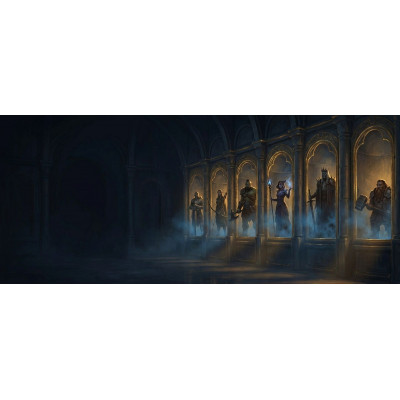
Cursed City is the mode you grind once you have already ground everything else: it feeds the Awakening system and rewards planning far more than raw roster power. Below is how a run works, which champions to bring, and what your in-run currency is actually worth spending on.
What the mode is and when it unlocks
Cursed City is a PvE mode that arrived together with the Awakening system and remains its main free source of materials. Everything here revolves around Souls: this is where most of your Soulstones and related resources come from, and those are what you later pour into raising Awakening levels on the champions you actually use.
It does not sit in your menu from day one — it unlocks as your account progresses, so a fresh player simply will not see it. If you have just started, stick to Campaign, Dungeons and Doom Tower first; the city can wait.
The key difference from other PvE content is structure. In a dungeon you know roughly what each stage holds; here you move across a map, and what you meet next depends on the route you picked.
How a run works: map, nodes, branches
- Pick a difficulty, assemble a team of five champions and enter the map.
- The map is a grid of nodes: regular fights, elite fights, shops, altars with buffs, healing spots and a boss at the end of a branch.
- You choose the route yourself: sprint down the short road to the boss, or loop around for more buffs and currency.
- Champion HP carries over from fight to fight. Fallen champions do not get back up on their own — healing nodes and your own abilities have to do that job.
- Fights drop an in-run currency, and only that currency spends in the local shops.
That leads to the core rule: a run is not about winning one battle, it is about reaching the end with a team still standing. Sometimes an extra healing node is worth more than a shortcut that leaves you facing the boss at half HP.
Team building: who to bring
There is no universal lineup, but the role logic is the same as everywhere else, adjusted for survivability:
- One or two damage dealers. More is wasted — without healing and backup they will not live to see the boss.
- A healer or shield support. Mandatory. Continuous regeneration and shields beat a single big heal here.
- A reviver. One champion who can bring an ally back forgives half the mistakes you make on the map.
- Buff and debuff support. Decrease ATK, Increase DEF, speed buffs — all of it stacks with the buffs you pick up during the run.
Poison and HP Burn shine against bosses: percentage-based damage does not need monstrous ATK. Kael, a starter with Poison, is the classic example of a champion who pays off in this kind of content — but he is not enough alone, you still need a second damage source and reliable survival.
Keep Accuracy high enough to land your key debuffs on the boss; a resisted Poison costs more than a couple of percent of damage. And do not drag glass-cannon nukers into the city without support around them.
Shops and buffs: where the currency goes
Inside a run you have two ways to invest — shop purchases and altar buffs. The priority is roughly this:
- Healing and revives if the team is hurting.
- Buffs matching your damage type: Poison, HP Burn, raw damage, Speed.
- DEF, HP and RES — the things that prevent a wipe.
- Everything else, if currency is left over.
Do not empty your wallet in the first shop: later nodes usually offer better options, and currency matters most right before the boss. Read the modifiers too — some curses punish exactly your strategy, for example by cutting debuff damage when your whole team is built on Poison.
Rewards: what you actually walk away with
The main payout is Soulstones of various tiers and Awakening materials, plus silver and assorted extras. Higher difficulty means better rewards, but the simple rule holds: clearing a mid difficulty consistently beats burning the top one once a week.
Awakening is a long game. It is not an evening upgrade but a gradual climb in stats and bonuses for champions you already use everywhere.
Common mistakes
- Running the same team every time and ignoring the modifiers.
- Skipping healing for the sake of speed.
- Taking the shortest road to the boss without a single buff.
- Buying everything in sight in the first shop.
Summary
Cursed City is about discipline, not roster strength. Build a balanced team with healing and a revive, do not get greedy with your route, and spend the in-run currency wisely — and the city becomes your most reliable source of Awakening materials. Start at a mid difficulty, tune the lineup, and only then push higher.
11/10/2026